Eyeforce Remote Guarding Solutions is now a Becklar Company...Learn More



Eyeforce Remote Guarding Solutions is now a Becklar Company...Learn More
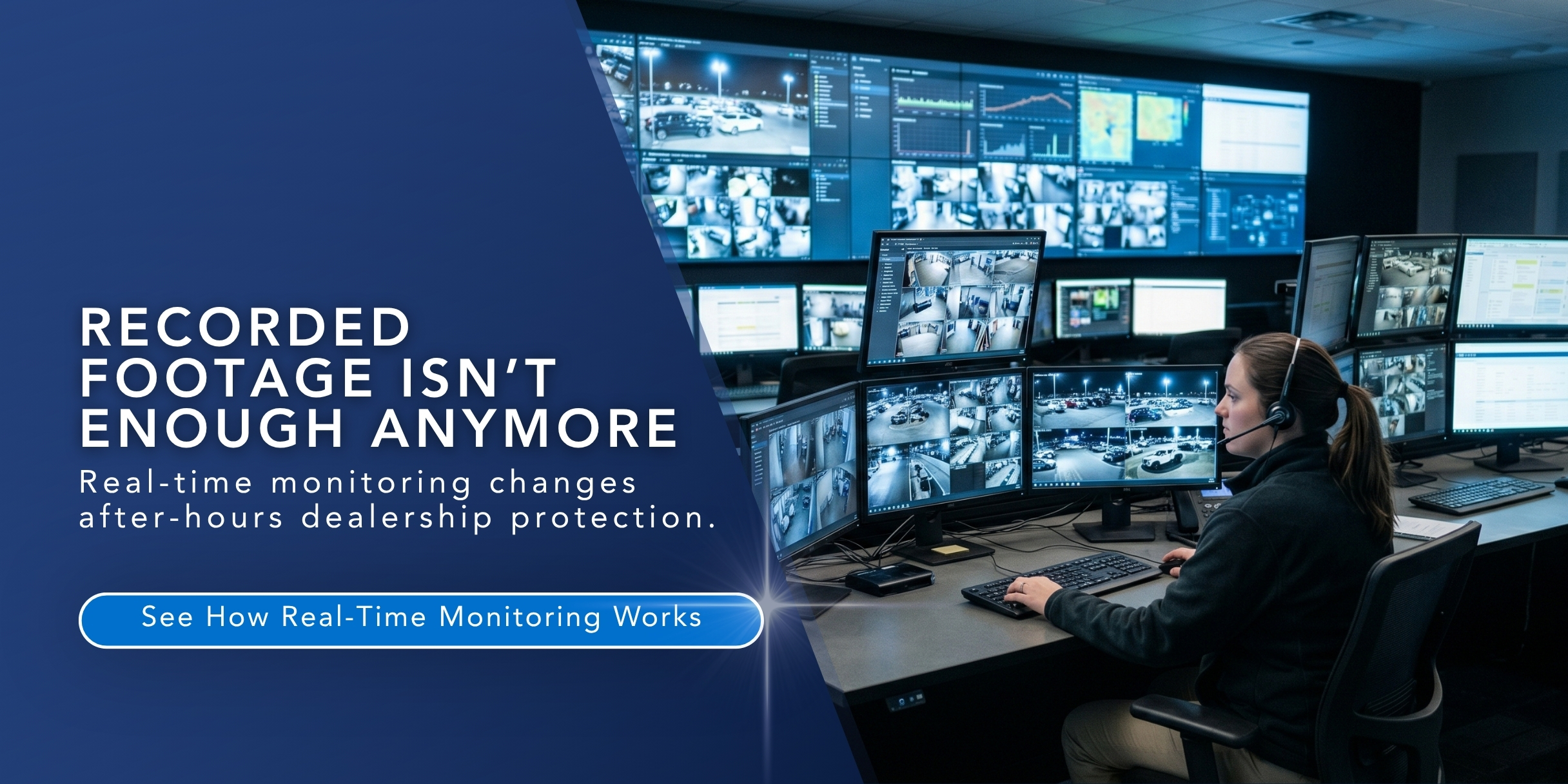
Walk most dealership properties after closing and you will see a familiar setup, with exterior cameras covering rows of inventory, service drives, and entry points while recording continuously across the lot. For years, that model has been considered sufficient because when an incident occurs, footage can be reviewed, timelines can be established, and the event can be documented.
The system works as intended within that framework, but it is still limited to explaining what has already happened. What has changed is not the presence of cameras, but the expectation of what those systems should accomplish, particularly as dealerships manage higher-value inventory, greater public visibility, and increasing pressure to maintain control across large, open environments.
Recorded video plays an important role in documenting events and supporting internal review, helping teams clarify what occurred while also providing information for insurance and compliance. It remains a necessary part of any dealership security strategy.
At the same time, it does not influence the outcome while an event is taking place. After-hours activity rarely begins as an obvious break-in and instead often starts with individuals moving through the lot, testing access points, or lingering near vehicles and service areas. When there is no visible response, that activity can escalate, and by the time it is discovered the next morning, the impact may already be clear. In this environment, the limitation is not visibility, but timing.
Becklar Video Remote Guarding addresses this gap by introducing real-time oversight into dealership environments, allowing activity to be monitored by trained specialists as it unfolds rather than only being reviewed after the fact. This creates an opportunity to act while behavior is still developing instead of relying on documentation after the outcome is already determined.
In practice, that means:
When these steps are applied consistently, the role of security shifts from documentation to active involvement, allowing the system to become part of how events are managed rather than simply how they are explained.
Dealership risk is not evenly distributed throughout the day. During business hours, staff presence, customer activity, and ongoing movement across the property create natural visibility and awareness, which helps limit how far issues can develop before they are addressed.
After hours, that structure shifts while the physical environment remains unchanged. Inventory stays in place, showrooms remain exposed to surrounding traffic, and large exterior areas become more difficult to monitor continuously. The result is a reduction in supervision without any reduction in exposure.
This is where the difference between passive and active systems becomes more apparent. A system that records activity may capture what happens overnight, while a system that monitors and responds can influence whether that activity develops at all.
As dealerships evaluate their security approach, the conversation is moving beyond camera placement and coverage and toward how those systems function within a broader operational strategy. Visibility remains important, but it is no longer the only factor that defines effectiveness.
A more complete model includes verification, response, and consistency, ensuring that activity is not just captured but assessed and addressed in a structured and reliable way. Becklar Video Remote Guarding supports this approach by working alongside existing camera infrastructure, allowing dealerships to extend the value of systems already in place through the addition of real-time oversight and intervention.
Dealership operations are built on control and accountability, with inventory tracked closely, financing structures requiring discipline, and customer experience managed with attention to detail. Security should operate with that same level of structure.
When monitoring becomes active rather than passive, it aligns more closely with how dealerships already manage other aspects of the business by introducing defined processes, clear thresholds for response, and consistent execution across the property. This alignment allows security to function as part of daily operations rather than as a reactive measure.
Moving beyond recorded footage does not require abandoning existing systems. Instead, it reflects a shift in how those systems are used, allowing dealerships to activate infrastructure that is already in place.
Rather than replacing cameras, real-time monitoring enables those systems to function as part of an active protection strategy. Over time, this changes how security is perceived, moving it from a passive safeguard to a controlled function that supports broader business objectives.
As expectations continue to evolve, dealerships will be asked to do more than document what has already occurred. They will be expected to maintain control over their environment, particularly during the hours when exposure is highest.
Recorded footage will remain part of the equation, but it will not be sufficient on its own. Becklar Video Remote Guarding supports this next step by enabling dealerships to move from passive recording to real-time oversight, helping protect high-value inventory and maintain control when it matters most.
To learn how Becklar Video Remote Guarding can support your dealership, visit the Becklar monitoring page or call (888) 393-3672.
Fill out the form, and we’ll be in contact with you to begin your consultation.
Or call us now at 888-393-3672
Fill out the form, and we’ll be in contact with you to begin your consultation.
Or call us now at



© 2025 Eyeforce Inc. Remote Guarding Solutions | All Rights Reserved | Terms of Use | Privacy & Security